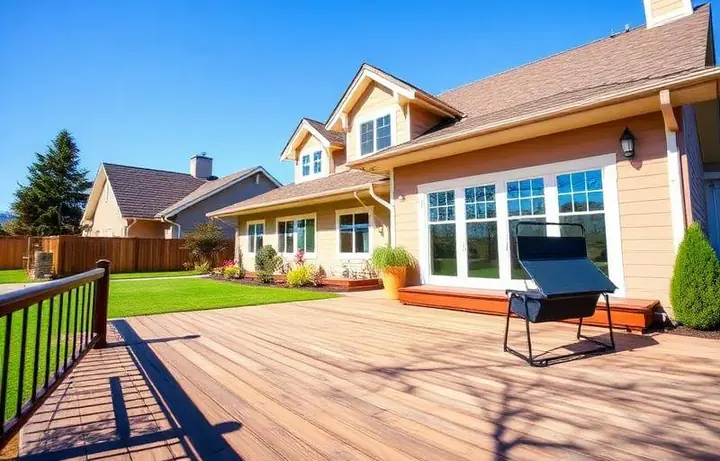
Composite vs Wood Cost Comparison
Composite costs roughly twice what pressure-treated pine does to install and needs almost nothing afterwards; wood is cheap to build and expensive to keep. The right answer depends entirely on how long you intend to own the deck. This runs both over the years you choose, including the staining and repairs wood needs, and shows where the lines cross.
Built and maintained by DixonAppStudio LLC · How the figures are worked out · Report an error
What you'll need
As an Amazon Associate I earn from qualifying purchases.

CAMO EDGEClip Universal Hidden Deck Fastener Clip (900 ct) | (0344356), 305 Stainless Gusset and Screw, Clip Creates 3/16 in (4.7 mm) Spacing, For Use With Composite Decking Boards
$349.40
Check price on Amazon
Ready Seal Exterior Wood Stain & Sealer, Natural Cedar, 5 Gallon | 5 Gallon semi-transparent "Goof Proof" oil-based stain & sealer for decks, fences, siding & pergolas; no primer, no streaks.
$189.94
Check price on Amazon
Tenino Copper Naphthenate 17% (2% as Metal) Double Strength - Highest Concentration Allowed - 1 Gallon - Wood Preservative
$66.95
Check price on Amazon
ShunHong Outdoor Solid Composite Decking Boards Color Samples Pack | Polymer Composite Decking for All Weather Use,Poolside,Backyard,Patio(3 Pcs, 0.5ft Color Samples)
$15.99
Check price on AmazonPrices as of Oct 25, 2026, 4:32 AM UTC. Product prices and availability are accurate as of the date/time indicated and are subject to change. Any price and availability information displayed on Amazon.com at the time of purchase will apply to the purchase of this product.
Shopping for someone? See our backyard gift guide for deck builders & DIYers.
The third option is cellular PVC — see the PVC deck cost calculator.
Decking a dock? Price the whole dock with the boat dock cost calculator.
The upfront cost gap is real — and shrinking
Composite decking costs about 2 to 2.5 times more per square foot installed than pressure-treated pine, and roughly 1.4 times more than cedar. That gap has narrowed steadily over the last decade as composite production has scaled and lumber prices have swung. In 2026, a 200 sqft composite deck typically runs $9,000–$13,000 installed versus $4,500–$6,500 for pressure-treated — a $4,000–$6,500 premium at the moment of purchase.
The 20-year total cost of ownership
The calculator above compares the upfront cost gap against 20 years of maintenance on a wood deck. Pressure-treated pine needs staining or sealing every 2–3 years ($400–$800 per cycle for a 200 sqft deck) plus a full board replacement around year 15 ($1,500–$3,000). Cedar is slightly better — 3–4 year cycles and a partial replacement around year 20. Composite requires soap and water twice a year and typically lasts the life of the substructure.
Add all of that up and composite typically breaks even at year 8 to 10 against pressure-treated, and year 12 to 14 against cedar. Beyond that, composite pulls clearly ahead. If you're planning to stay in the home five years or fewer, wood is still the smarter money — the buyer of your house won't pay a $6,000 premium for a composite deck they didn't choose.
What the calculator can't quantify
Two variables move the answer that the math doesn't capture: your tolerance for maintenance, and your climate. In the Pacific Northwest and the Sunbelt, wood deteriorates 30–50% faster than the national average — composite makes sense sooner. In dry climates like Denver or Phoenix, wood can outlast the calculated cycles and push the breakeven year further out.
Resale value
Zonda's 2025 Cost vs. Value report (national averages) puts the share of cost recouped at resale at 94.9% for a wood deck addition ($18,263 job) and 88.5% for a composite deck addition ($25,096 job). Composite adds more dollars at resale but recovers a smaller share of its higher cost, and wood loses value if it's visibly aged. If you plan to sell in 3–7 years, refinished cedar or pressure-treated is the highest-ROI choice.
Making the final call
Composite wins for homeowners staying 8+ years, disliking maintenance, or building in harsh climates. Wood wins for shorter time horizons, tighter budgets, or homeowners who like the smell of fresh stain in April. Read the full breakdown in our composite vs wood deep-dive for a decision framework that matches your specific situation.
Get the Smart Decking Calculator app for Android
Estimate decks on the go, save projects, and share them with contractors.
Building something else? Try our sister calculators
Smart Fencing Calculator
Estimate fence cost by material and linear footage.
Smart Roofing Calculator
Free roof replacement cost estimates by material.
Fence Calculator
Android app — posts, pickets, panels and fence cost.
Gravel & Stone Calculator
Android app — gravel under the deck and footings, in tons and yards.
Roofing Calculator
Android app — roof squares, shingles and covered-deck roofs.
Drywall Calculator
Android app — drywall sheets, mud, and tape estimates.
Frequently asked questions
- Is composite decking cheaper than wood in the long run?
- Usually, if you keep the deck more than about eight to twelve years. Pressure-treated pine is roughly half the installed cost but needs cleaning and staining every two to three years and board replacement as it splits and cups. Composite costs more up front and needs washing. Run your own numbers over your actual ownership horizon — under about eight years, wood still wins.
- How long does composite decking last compared to wood?
- Composite typically carries a 25 to 30 year warranty and lasts about that. Pressure-treated pine gets 10 to 15 years before boards start needing replacement, cedar 15 to 20, and tropical hardwood 25 or more if it is maintained. The frame underneath is pressure-treated lumber in all cases, so its lifespan is the real ceiling.
- Does composite decking get hot?
- Yes, noticeably hotter than wood in direct sun, and dark colours worst of all. It is the most common complaint from owners who did not expect it. Lighter colours, shade over part of the deck, and the capped products that reflect more heat all help. If the deck faces full afternoon sun and people will be barefoot, test a sample board outdoors before choosing a colour.
- Can I mix composite decking with a wood frame?
- Yes, and nearly everyone does — composite is a decking material, not a framing material, so the joists, beam and posts are pressure-treated lumber underneath either way. The one thing to check is spacing: most composite brands require joists at 16 inches on centre and 12 for diagonal layouts, which is tighter than an older wood deck may have been framed.