Deck Beam Span Calculator
The beam is the member everything else depends on, and the one most often undersized on a homeowner-built deck. Its size comes from two numbers working together: how far apart the posts are, and how much deck depth it carries. This sizes the beam and the posts from those two, and gives you the ply count and lumber total to buy.
Built and maintained by DixonAppStudio LLC · How the figures are worked out · Report an error
What you'll need
As an Amazon Associate I earn from qualifying purchases.

LIONMAX Lag Screws 6 Inch, Structural Wood Screws #14 x 6, 50-PCS, Black | Heavy Duty Timber Screws 6 Inch, Rust Resistant for Exterior Wood/Log/Deck/Construction, Washer Head, T30 Star Drive with Bit
Save 5%
$18.71Typical price:: $19.70

50 Pack 2x10 Joist Hangers, 18 Gauge Galvanized Face Mount | Wood connectors for rafters, beams and framing projects; suitable for decks, floors and pergolas.
$74.99
Check price on Amazon
#14 x 5 Wood Structural Lag Screws | 54Pcs Star Drive Decking Wood Screws, Rust Resistant Timber Screws for Timber/Log/Landscaping Wood
Save 5%
$19.84Typical price:: $20.89

BNUOK Lag Screws #14 x 6 Inch, (1lb, 20pcs) Heavy Duty Construction Structural Exterior Wood Timber Screws, Torx Drive Washer Head Rust Resistant Black Epoxy Coated, with T30 Star Bit
$8.99
Check price on AmazonPrices and savings as of Oct 25, 2026, 4:32 AM UTC. Product prices and availability are accurate as of the date/time indicated and are subject to change. Any price and availability information displayed on Amazon.com at the time of purchase will apply to the purchase of this product.
Shopping for someone? See our guide to gifts for woodworkers.
Counting posts and footing loads? Use the deck post spacing calculator.
What a beam does and why size matters
The beam is the horizontal member that runs perpendicular to your joists and carries their load down into the posts. Undersize the beam and the deck bounces, sags, and eventually fails — the number-one structural mistake on DIY decks. Oversize it and you're spending money on lumber you don't need. The calculator above returns the maximum allowable span for common built-up beams based on the joist length they'll support.
How the span table works
Beam capacity is a function of three things: lumber size, ply count (how many 2× members are nailed or bolted together to form the beam), and the tributary joist length feeding into it. A single joist carries load to two supports — the ledger and the beam — so a beam supporting joists that span 12 feet has a tributary width of 6 feet. Longer joists mean shorter allowable beam spans between posts.
Beam sizing quick reference
- 2-ply 2×8: 6–9 ft between posts, best for small ground-level decks.
- 2-ply 2×10: the residential standard, 8–11 ft between posts.
- 3-ply 2×10: stiffer and longer spans, 10–13 ft, ideal for wider decks.
- 2-ply 2×12: deep and stiff, 10–13 ft between posts.
- 3-ply 2×12: maximum span, 12–16 ft, used on large or elevated decks.
Built-up beams versus solid timbers
Almost every residential deck uses a built-up beam — multiple 2× members bolted or nailed together. It's cheaper and easier to handle than a solid timber. For 2-ply beams, use 10d galvanized nails at 16" OC top and bottom; for 3-ply, use 1/2" through-bolts every 24" with washers on both sides. Ring-shank nails or structural screws (Simpson SDW or GRK RSS) also meet code and hold better long-term.
Where beams fail in the real world
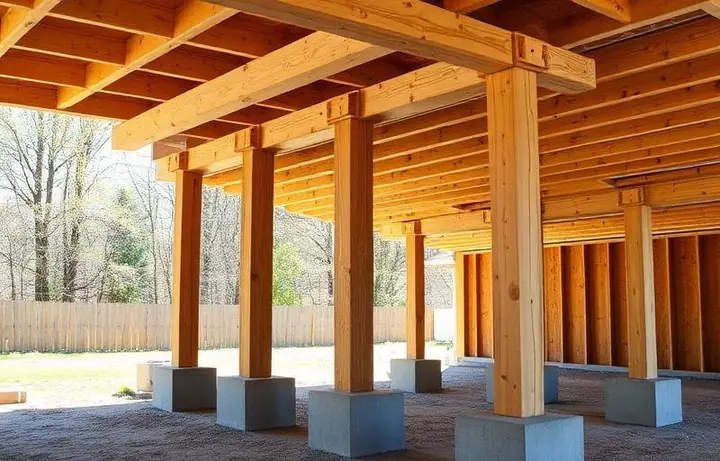
Rot is the enemy. Never notch a post into a beam — always run the beam across the top of the post and attach with a Simpson post cap. Also install cap flashing over the top of any beam that will be exposed to sky-facing rain, since built-up beams trap water in the seams and rot from the inside out. Confirm your post count and post size once you've locked in the beam using our deck post calculator.
Code compliance
The numbers above match AWC DCA-6, the prescriptive residential deck code adopted by most US jurisdictions. Local codes can differ — hot tub or roof loads always require a stamped engineered design. When in doubt, size up one lumber grade and confirm with your building inspector before you order.
Get the Smart Decking Calculator app for Android
Estimate decks on the go, save projects, and share them with contractors.
Building something else? Try our sister calculators
Smart Fencing Calculator
Estimate fence cost by material and linear footage.
Smart Roofing Calculator
Free roof replacement cost estimates by material.
Fence Calculator
Android app — posts, pickets, panels and fence cost.
Gravel & Stone Calculator
Android app — gravel under the deck and footings, in tons and yards.
Roofing Calculator
Android app — roof squares, shingles and covered-deck roofs.
Drywall Calculator
Android app — drywall sheets, mud, and tape estimates.
Frequently asked questions
- What size beam do I need for a deck?
- It is set by the post spacing and the tributary width — half the joist span it carries. As a rough guide in Southern Yellow Pine, a doubled 2x8 spans about 6 ft between posts carrying a 12 ft deck, a doubled 2x10 about 7 ft 6 in, and a tripled 2x10 about 9 ft. Always check against the beam span table in DCA 6 or your local code, because species changes the answer.
- Can a deck beam be built from two boards nailed together?
- Yes — a built-up beam of two or three plies is the normal residential construction, fastened together in a specific nailing or bolting pattern. What matters is that the plies act as one: fasteners at the spacing your code specifies, plies the same length with joints staggered over posts, and no gaps for water to sit in. Cap the top or slope the joints so it drains.
- Should the beam sit on top of the posts or bolt to the sides?
- On top, on a rated post cap, whenever you can. That path puts the load straight down through the post in compression, which is what wood is best at. Side-bolting — a sandwich beam either side of the post — depends entirely on the bolts in shear and is far more sensitive to being done wrong. Some jurisdictions no longer accept it at all.
- How far can a deck beam span between posts?
- For ordinary residential framing, eight feet is the practical maximum and six is common. Going further means a deeper beam or more plies, and the extra lumber usually costs more than the footing you saved. Beam span also has to be checked against the deck depth it carries — the same beam reaches less as the deck gets deeper.