Deck Footing & Concrete Calculator
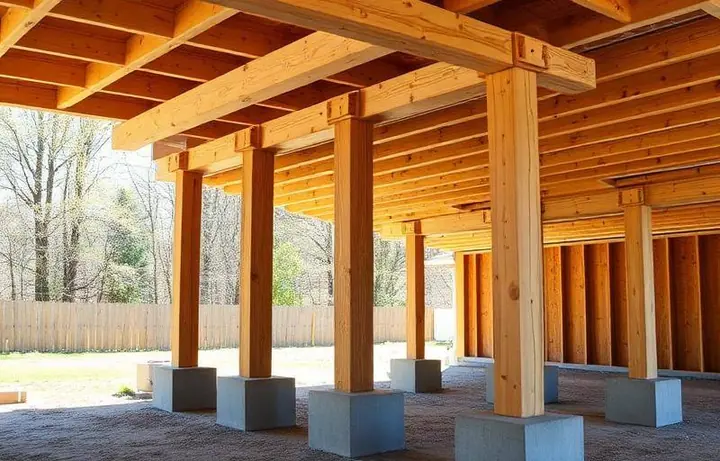
Footings are the part of a deck nobody sees, cannot be fixed afterwards, and are the reason decks move. Size and depth come from the load each post carries and the frost line where you live. This works out how many footings you need, how they should be spaced and what diameter suits the load, along with the concrete volume to order.
Built and maintained by DixonAppStudio LLC · How the figures are worked out · Report an error
What you'll need
As an Amazon Associate I earn from qualifying purchases.

SIKA Sikacryl Ready-Mix Concrete Repair Patch, Gray, Textured, 1 qt 1-Pack | Repairs spalls and cracks in masonry, Ready-to-use acrylic formula, Durable finish, Easy cleanup and application
$9.99
Check price on Amazon
CNCRT BLD FRM TUBE 10"D | Concrete form, cylindrical tube, construction accessory, foundation forming supply
Save 6%
$74.96Typical price:: $79.47

MAXCCINO Auger Drill Bit for Planting 2"(D) x14.5(L), Garden Ground Earth Spiral Drill Bit for 3/8" Hex Drive Drill, for Post Hole Digger Bulb Bedding Digging Plant Rapid Planter
Save 17%
$9.99List Price:: $11.99

AXWHYS 4x4 Post Base 8 Pcs, (Inner Size 3.6x3.6) Post Anchors, 13GA Thick Solid Steel & Black Powder Coated,Deck Post Brackets Support Deck Base Plate Pergola Brackets Fence Kit Mailbox Mount…
$69.99
Check price on AmazonPrices and savings as of Oct 25, 2026, 4:32 AM UTC. Product prices and availability are accurate as of the date/time indicated and are subject to change. Any price and availability information displayed on Amazon.com at the time of purchase will apply to the purchase of this product.
Shopping for someone? See our backyard gift guide for deck builders & DIYers.
Not sure of the load on each footing? The deck post spacing calculator works it out.
Low freestanding deck? The deck block calculator counts precast blocks instead.
Pouring into tube forms? Bags per tube and tubes to buy with the Sonotube calculator.
Poured piers, blocks, helical piles or ground screws? Compare the deck footing options.
Choosing a digger or auger? See our post hole digger buying guide for footing-size holes.
Concrete quantities that actually match the hole
Footings look simple until you're standing next to a 12-inch auger hole trying to figure out how many bags to buy. The calculator above computes the exact volume of each hole (as a cylinder), multiplies by your footing count, and converts to both 60-lb and 80-lb bag counts. Because concrete slumps and forms are rarely perfectly cylindrical, always buy 10–15% more than the calculated number — a bag over-buy is far cheaper than a mid-pour Home Depot run.
Sizing footings correctly
Footing diameter and depth depend on soil bearing capacity, frost depth, and the load coming down through the post. General residential guidance:
- Diameter: 10–12 inches for small ground-level decks, 12–16 inches for standard elevated decks, 16–24 inches for hot tub or heavy roof loads.
- Depth: at least 12 inches below the local frost line. That's 12" in the South, 42–48" in the Upper Midwest and Northeast, 60" in far-northern climates.
- Bell base: in weak soils, flare the bottom of the hole to 2× the shaft diameter for extra bearing.
60 lb vs 80 lb bags — which to buy
An 80-lb bag yields about 0.6 cubic feet; a 60-lb bag yields 0.45 cubic feet. Doing the math per hole: a 12-inch × 42-inch footing holds 2.75 cubic feet of concrete — 5 bags of 80-lb or 7 bags of 60-lb, before the 10% spillage allowance. For anything over 6 footings, buy 80-lb bags and mix in a wheelbarrow or a rented mixer. For fewer than 6 or if you're mixing by hand in a bucket, 60-lb is easier on your back and faster to hydrate.
Deck footing size chart: concrete per footing
The same cylinder maths the calculator uses, worked out for the common tube sizes and depths. Each cell is the volume of one footing, then the 80-lb and 60-lb bag count for that one hole (rounded up, no spillage allowance).
| Diameter | 24 in deep | 36 in deep | 42 in deep | 48 in deep |
|---|---|---|---|---|
| 8 in | 0.70 cu ft · 2 / 2 | 1.05 cu ft · 2 / 3 | 1.22 cu ft · 3 / 3 | 1.40 cu ft · 3 / 4 |
| 10 in | 1.09 cu ft · 2 / 3 | 1.64 cu ft · 3 / 4 | 1.91 cu ft · 4 / 5 | 2.18 cu ft · 4 / 5 |
| 12 in | 1.57 cu ft · 3 / 4 | 2.36 cu ft · 4 / 6 | 2.75 cu ft · 5 / 7 | 3.14 cu ft · 6 / 7 |
| 16 in | 2.79 cu ft · 5 / 7 | 4.19 cu ft · 7 / 10 | 4.89 cu ft · 9 / 11 | 5.59 cu ft · 10 / 13 |
| 18 in | 3.53 cu ft · 6 / 8 | 5.30 cu ft · 9 / 12 | 6.19 cu ft · 11 / 14 | 7.07 cu ft · 12 / 16 |
| 24 in | 6.28 cu ft · 11 / 14 | 9.42 cu ft · 16 / 21 | 11.00 cu ft · 19 / 25 | 12.57 cu ft · 21 / 28 |
Bag counts read as 80-lb / 60-lb. Volume grows with the square of the diameter, so going from a 12-inch to a 16-inch tube nearly doubles the concrete (2.75 to 4.89 cu ft at 42 inches) — and nearly doubles the bearing area, which is why you upsize the diameter rather than the depth when a post carries more load.
How many footings for common deck sizes
One footing per post. Posts go at each end of every beam and no more than 8 ft apart between; a beam line is needed for every 12 ft of joist span, and a freestanding deck adds the beam a ledger would otherwise replace. That is the same logic as the deck post calculator. Bag totals assume 12-inch footings 42 inches deep in 80-lb bags.
| Deck (along house × out) | Attached: footings | 80-lb bags | Freestanding: footings | 80-lb bags |
|---|---|---|---|---|
| 10 × 10 ft | 3 | 14 | 6 | 28 |
| 12 × 12 ft | 3 | 14 | 6 | 28 |
| 16 × 12 ft | 3 | 14 | 6 | 28 |
| 20 × 10 ft | 4 | 19 | 8 | 37 |
| 24 × 12 ft | 4 | 19 | 8 | 37 |
| 16 × 16 ft | 6 | 28 | 9 | 42 |
| 20 × 20 ft | 8 | 37 | 12 | 55 |
Worked example: a 20 × 20 ft deck has a 20 ft joist span, which is more than a joist can reach, so it needs two beam lines even when it is ledgered to the house. Each 20 ft beam needs posts at 0, 6.7, 13.3 and 20 ft — four posts — so 8 footings attached, or 12 freestanding with a third beam at the house side. At 2.75 cu ft each, the attached version is 22 cu ft of concrete: 37 eighty-pound bags, about 40 with spillage. Add a footing or landing pad at the foot of any stairs. Size the beam between those posts with the deck beam calculator, and look up your frost depth in the deck footing depth guide.
How heavy is a concrete deck footing?
Work it from the bags: a standard 12 × 42 inch footing takes 2.75 cubic feet, or about 4.6 eighty-pound bags, so roughly 365 lb of dry mix goes into each hole before water is added. A 16 × 48 inch footing takes 5.59 cubic feet, or around 745 lb of mix. That weight is part of why poured footings resist uplift and why precast deck blocks — which weigh far less and sit on the surface — are only suitable for low floating decks.
Fast-set vs standard mix
Fast-setting concrete (Quikrete Fast-Setting, Sakrete 5000 Fast) sets in 20–40 minutes and reaches structural strength in a few hours. Use it if you're pouring on a weekend and want to attach posts the same day. Standard concrete is cheaper and stronger long-term but needs 24–48 hours before you can start framing. Both meet code for residential deck footings when they hit their rated PSI.
Post-to-footing connection
Never bury a wood post directly in concrete — it will rot in 8–15 years no matter how treated it is. Set an approved post base (Simpson ABU or PB series) into the wet concrete with the top of the base at least 1 inch above finished grade. This lifts the post out of standing water and lets it dry between rains. Once your concrete is set, run the numbers on the framing above with our beam span calculator.
Get the Smart Decking Calculator app for Android
Estimate decks on the go, save projects, and share them with contractors.
Building something else? Try our sister calculators
Smart Fencing Calculator
Estimate fence cost by material and linear footage.
Smart Roofing Calculator
Free roof replacement cost estimates by material.
Fence Calculator
Android app — posts, pickets, panels and fence cost.
Gravel & Stone Calculator
Android app — gravel under the deck and footings, in tons and yards.
Roofing Calculator
Android app — roof squares, shingles and covered-deck roofs.
Drywall Calculator
Android app — drywall sheets, mud, and tape estimates.
Frequently asked questions
- How deep do deck footings need to be?
- Below the frost line for your area, which your building department publishes and will not waive — 12 inches in parts of the south, 42 to 48 inches across much of the north, and deeper in the coldest regions. A footing that stops short gets lifted every time the ground freezes, which racks the frame and pulls the ledger away from the house.
- How many footings does a deck need?
- One under each post, with posts at no more than eight feet along each beam and often six. A 16 by 12 ft attached deck typically needs three or four footings along a single beam; the same deck freestanding needs two beams and roughly double. Stairs need their own footing or landing pad at the bottom.
- What diameter should deck footings be?
- Twelve inches suits most residential decks on firm soil. Softer soils, taller decks and any post carrying a roof, a hot tub or a multi-level structure want more — 16 or 18 inches, or a flared base that spreads the load over a wider area. The footing is sized on bearing area, so doubling the diameter quadruples what it can carry.
- How many bags of concrete per deck post?
- Work out the hole volume and divide by the bag yield: an 80 lb bag makes about 0.60 cubic feet and a 60 lb bag about 0.45. A 12 in round footing 42 in deep holds 2.75 cubic feet, so 5 bags of 80 lb or 7 of 60 lb per post. A 10 in hole 36 in deep holds 1.64 cubic feet, or 3 bags of 80 lb. Buy one spare bag per few holes for spillage.
- How many footings do I need for a 20x20 deck?
- Eight if it is attached to the house, twelve if it is freestanding. A 20 ft joist span is too long for joists alone, so the deck needs two beam lines plus the ledger; each 20 ft beam needs four posts at no more than 8 ft apart (0, 6.7, 13.3 and 20 ft). Freestanding adds a third beam where the ledger would be. At 12 by 42 inch footings that is about 37 eighty-pound bags of concrete attached, or 55 freestanding.
- What size footing do I need for a deck?
- For most residential decks on firm soil, a 12 inch diameter footing is the standard; 16 to 18 inches suits posts that carry more area, a roof or a hot tub, and 24 inches or a flared base is for heavy point loads or soft soil. Depth is set by your frost line, not by the load. A 12 inch footing 42 inches deep holds 2.75 cubic feet of concrete; a 16 inch one at the same depth holds 4.89.
- How heavy is a concrete deck footing?
- Count the bags: a 12 by 42 inch footing holds 2.75 cubic feet, which is about 4.6 eighty-pound bags, so roughly 365 lb of dry mix goes into it. A 16 by 48 inch footing holds 5.59 cubic feet, around 745 lb of mix. That mass is what lets a poured footing resist frost heave and uplift in a way a surface deck block cannot.
- Can I use deck blocks instead of poured footings?
- Only for a low, freestanding, unpermitted deck. Precast blocks sit above the frost line by definition, so the deck rides seasonal ground movement instead of resisting it. That is acceptable on a ground-level floating deck and not acceptable on anything attached to the house, anything elevated, or anything a permit covers.