Deck Joist Calculator
Joists carry everything on the deck and hand it to the beam. Size them from the span and spacing, not from what looks sturdy — a joist that is one size small does not fail dramatically, it just bounces underfoot for twenty years and sags where the furniture sits. This works out the count, the lumber total and the blocking from your deck's dimensions.
Built and maintained by DixonAppStudio LLC · How the figures are worked out · Report an error
What you'll need
As an Amazon Associate I earn from qualifying purchases.

50 Pack 2x10 Joist Hangers, 18 Gauge Galvanized Face Mount | Wood connectors for rafters, beams and framing projects; suitable for decks, floors and pergolas.
$74.99
Check price on Amazon
FrogTape Pro Grade Deck and Joist Flashing Tape, 1.89 in x 50 Feet, Black | 2" Wide Tape, All Weather Application, UV Resistant Joist Tape for Wood, Beams with Repositionable Acrylic Adhesive, 13 mils
$18.75
Check price on Amazon
LIONMAX Lag Screws 6 Inch, Structural Wood Screws #14 x 6, 50-PCS, Black | Heavy Duty Timber Screws 6 Inch, Rust Resistant for Exterior Wood/Log/Deck/Construction, Washer Head, T30 Star Drive with Bit
Save 5%
$18.71Typical price:: $19.70

CRAFTSMAN 25-Ft Tape Measure with Fraction Marketing, Retractable, Manual-Locking Blade (CMHT37443S)
Save 35%
$12.98Typical price:: $19.98
Prices and savings as of Oct 25, 2026, 4:32 AM UTC. Product prices and availability are accurate as of the date/time indicated and are subject to change. Any price and availability information displayed on Amazon.com at the time of purchase will apply to the purchase of this product.
Shopping for someone? See our guide to best gifts for deck builders & diy deck builders.
Planning an overhang? See the deck cantilever calculator.
Protecting the joists? Count rolls with the joist tape calculator.
Hanging them from a ledger? Count hangers and nails with the joist hanger calculator.
Mixing board lengths? Count them with the lumber calculator.
Choosing joist tape? See our joist tape buying guide.
Joist spacing determines everything else
Joist spacing is the single most important framing decision on a deck — it dictates how much lumber you buy, what decking materials you can use, how bouncy the finished deck feels, and how long the boards last. The industry standard is 16 inches on center, which supports every common decking material and gives a solid, no-flex walking surface. Composite installations on diagonal patterns require tighter 12-inch spacing, and pressure-treated 2×6 boards on light-load residential decks can go as wide as 24 inches — though most builders avoid it.
Reading the calculator's output
The number above counts every joist in the deck's field, including both end joists. It does not include the two rim joists that cap the ends (perpendicular to the field joists) or the ledger board that attaches to the house. For a complete framing lumber list, add 3 to the joist count returned above and buy those separately in the same 2×8, 2×10, or 2×12 stock size as your field joists.
Picking the right joist size
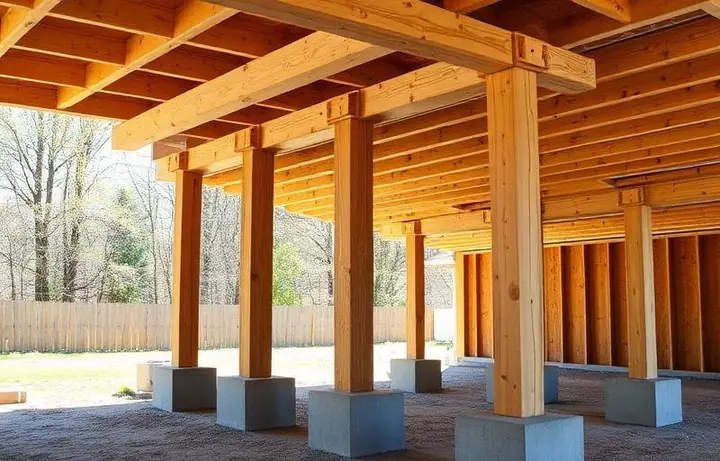
Joist size depends on how far the joists span between beams or the ledger and a beam:
- 2×6: up to 8 ft span at 16" OC
- 2×8: up to 12 ft span at 16" OC
- 2×10: up to 15 ft span at 16" OC
- 2×12: up to 18 ft span at 16" OC
These are conservative numbers based on AWC DCA-6 for southern pine or SPF at 40 psf live load. If your deck will support a hot tub, use one size larger than the table suggests and confirm with a structural engineer.
What to buy alongside your joists
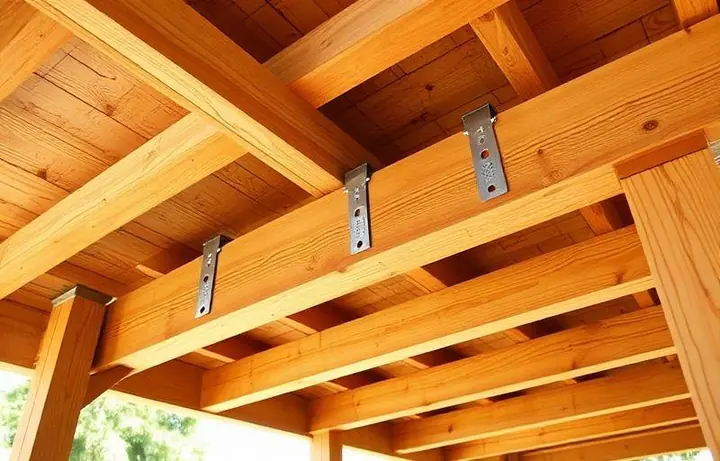
Every joist needs a joist hanger at each end where it meets the ledger or a beam — the industry standard is Simpson Strong-Tie LUS or LSSU depending on skewed conditions. Budget one joist hanger per joist end (2 per joist), plus a handful of extras. Also plan on joist protection tape (butyl or asphaltic peel-and-stick) applied to the top edge of every joist — it prevents water from wicking into the top fiber and doubles the frame's lifespan for less than $100 on a typical deck.
Blocking, bridging, and the details that matter
Any joist run over 8 feet should get midspan blocking (short pieces of joist stock installed perpendicular between the joists) to prevent twist and increase lateral stiffness. Most inspectors require it on spans over 10 feet regardless. Cross-bridging (X-shaped 1×3s) is an older technique that's fallen out of favor — solid blocking is stiffer and faster to install. Once your joists are down, run the numbers on your supporting beams to make sure the whole system spans safely.
Get the Smart Decking Calculator app for Android
Estimate decks on the go, save projects, and share them with contractors.
Building something else? Try our sister calculators
Smart Fencing Calculator
Estimate fence cost by material and linear footage.
Smart Roofing Calculator
Free roof replacement cost estimates by material.
Fence Calculator
Android app — posts, pickets, panels and fence cost.
Gravel & Stone Calculator
Android app — gravel under the deck and footings, in tons and yards.
Roofing Calculator
Android app — roof squares, shingles and covered-deck roofs.
Drywall Calculator
Android app — drywall sheets, mud, and tape estimates.
Frequently asked questions
- What size joists do I need for a deck?
- It depends on the span and the spacing. Using the AWC DCA 6 tables for Southern Yellow Pine at 16 inches on centre, a 2x6 reaches about 9 ft, a 2x8 about 11 ft 11 in, a 2x10 about 14 ft and a 2x12 about 16 ft 6 in. Douglas Fir-Larch is slightly less, Hem-Fir and cedar less again. Tightening to 12 inches on centre buys about a foot on most sizes.
- How far apart should deck joists be?
- Sixteen inches on centre is the standard and suits nearly everything. Twelve inches is required for most composite and PVC decking laid diagonally, and by some brands for straight installation too. Twenty-four inches is only permitted with 2x thick wood decking — 5/4 boards and composite both deflect noticeably at that spacing.
- Can deck joists be doubled instead of going up a size?
- Doubling a joist roughly doubles its load capacity but does very little for its span, because span is governed by depth. Two 2x8s side by side still reach about the same distance as one. Doubling is the right answer under a point load — a hot tub, a planter, a stair landing — and the wrong answer when you simply need to reach further. For that, go deeper.
- Which way should deck joists run?
- Perpendicular to the decking boards, and usually perpendicular to the house so they can hang off a ledger and land on a beam at the outer edge. That also sets your board direction: boards run parallel to the house in the usual layout. If you want the boards running the other way, the frame rotates with them and the beam moves to the side.
- How much joist tape do I need?
- Add up the top edge of every joist and rim, allow 10 percent for laps, and divide by the roll length — usually 50 ft. A 16 ft joist run on a 12 ft wide deck at 16 inches on centre has 10 joists, or 160 ft, plus a 12 ft rim board: 172 ft, 189 ft with the allowance, so four 50 ft rolls of 2 inch tape. Tape the beam with 4 to 6 inch tape, and the ledger with flashing rather than tape alone.