Best Deck Paint: Paint, Resurfacer or Solid Stain?
What each coating is for, the label specs that matter, and how many gallons your deck takes — worked out with our stain calculator.
Updated · by the Smart Decking Calculator team
As an Amazon Associate I earn from qualifying purchases. This guide is written from product specifications, building-code requirements and our calculators — it is not a hands-on product test. Affiliate disclosure
“Deck paint” covers three different products: acrylic porch-and-floor paint, thick textured resurfacers, and solid-colour stains. They look similar in the can and behave very differently on a deck. The best one depends on the state of your boards — sound boards that just look tired want a solid stain or a floor paint; cracked, splintered boards are what resurfacers were made for.
This guide compares the types side by side, lists what to read on the label, and works out gallons with the same function as our deck stain calculator.
Compared by type
Pros and cons describe each type from its specifications. The product in each row is a current, well-rated option of that type on Amazon, refreshed twice a day — check the listing's specifications against the “check” line before you buy.
Solid-colour deck stain
Best for: Sound, weathered wood where you want an even colour
 Thompson’s WaterSeal Solid Color Waterproofing Wood Stain and Sealer, Chestnut Brown, 1 Gallon$35.78Check price on Amazon
Check: “Solid” on the label, and whether it is rated for horizontal surfaces
- Thin enough to soak in, so it fails by wearing rather than peeling in sheets
- Hides grey and patchy boards
- Easiest of the three to recoat
- Wears through first on stairs and traffic lanes
- Hides the grain completely
- Still needs a clean, dry, bare-wood surface
Porch & floor paint (acrylic)
Best for: Porches, stair treads and decks you want to look painted
 Glidden Grab-N-Go Porch and Floor Interior/Exterior Paint, 1 Gallon, Satin, Dark Gray, 128 Fl Oz (Pack of 1)$37.47Check price on Amazon
Check: Rated for exterior floors (not walls), and the recoat time
- Hard, cleanable film in any colour
- Covers roughly 300 sq ft per gallon on smooth wood
- Many can be tinted and made slip-resistant with an additive
- A film can peel if water gets under it
- Once painted, going back to stain means stripping
- Slippery when wet unless grit is added
Deck resurfacer (textured coating)
Best for: Old boards with small cracks and splinters
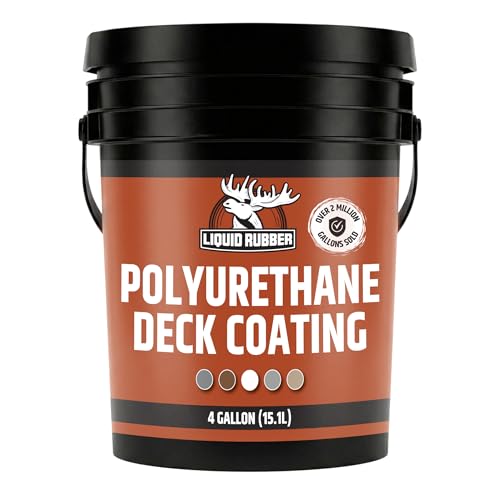 Liquid Rubber Polyurethane Deck Coating - Textured, Stone Grey, 4 Gallon$299.95Check price on Amazon
Check: Coverage per gallon per coat and the maximum crack width it fills
- Very thick film fills small cracks and binds splinters
- Textured, barefoot-friendly surface
- Buys years on boards that are otherwise sound
- Low coverage — often 50 to 100 sq ft per gallon per coat
- Heavy film can trap moisture and fail in sheets
- Hard to remove later; will not fix rot or loose boards
Anti-slip additive or coating
Best for: Stairs, pool decks and shaded, damp boards
 FIXALL Skid Grip Anti-Slip Coating, 1 Gallon, Smoke, Exceeds ADA Standards, Ideal for Safety Areas, Slip-Resistant Pavement, Cement & Concrete Paint$42.50Check price on Amazon
Check: Which coatings it is compatible with, and the mixing rate
- Adds grip to paint or solid stain
- Cheap relative to the paint
- Can be broadcast on stair treads only
- Rough underfoot
- Makes the surface harder to clean
- Settles in the can — stir often
Applicators (pad, roller, brush)
Best for: Getting an even coat into gaps and board ends
 Pro Grade Paint Roller Kit, Paint Brushes, 4" & 9" Roller Covers for Walls$17.79Check price on Amazon
Check: Nap or pad size to suit a smooth or rough surface
- A pad on a pole is fastest on board tops
- A roller with thick nap suits resurfacers
- A brush reaches gaps, ends and railings
- Rollers can leave too much film in one pass
- Cheap pads shed fibres
- Resurfacers ruin applicators — plan on disposable ones
| Type | Current option | Pros | Cons |
|---|---|---|---|
| Solid-colour deck stainBest for: Sound, weathered wood where you want an even colourCheck: “Solid” on the label, and whether it is rated for horizontal surfaces | Thompson’s WaterSeal Solid Color Waterproofing Wood Stain and Sealer, Chestnut Brown, 1 Gallon$35.78Check price on Amazon |
|
|
| Porch & floor paint (acrylic)Best for: Porches, stair treads and decks you want to look paintedCheck: Rated for exterior floors (not walls), and the recoat time | Glidden Grab-N-Go Porch and Floor Interior/Exterior Paint, 1 Gallon, Satin, Dark Gray, 128 Fl Oz (Pack of 1)$37.47Check price on Amazon |
|
|
| Deck resurfacer (textured coating)Best for: Old boards with small cracks and splintersCheck: Coverage per gallon per coat and the maximum crack width it fills | Liquid Rubber Polyurethane Deck Coating - Textured, Stone Grey, 4 Gallon$299.95Check price on Amazon |
|
|
| Anti-slip additive or coatingBest for: Stairs, pool decks and shaded, damp boardsCheck: Which coatings it is compatible with, and the mixing rate | FIXALL Skid Grip Anti-Slip Coating, 1 Gallon, Smoke, Exceeds ADA Standards, Ideal for Safety Areas, Slip-Resistant Pavement, Cement & Concrete Paint$42.50Check price on Amazon |
|
|
| Applicators (pad, roller, brush)Best for: Getting an even coat into gaps and board endsCheck: Nap or pad size to suit a smooth or rough surface | Pro Grade Paint Roller Kit, Paint Brushes, 4" & 9" Roller Covers for Walls$17.79Check price on Amazon |
|
|
Prices as of Sep 30, 2026, 4:35 AM UTC. Product prices and availability are accurate as of the date/time indicated and are subject to change. Any price and availability information displayed on Amazon.com at the time of purchase will apply to the purchase of this product.
What to look for on the label
- Horizontal-surface rating. Wall paint on a deck floor peels within a season; buy a product rated for decks, porches or floors.
- Coverage per gallon per coat. Paint and solid stain are usually 200–400 sq ft; resurfacers are far lower. Compare price per square foot, not per can.
- Recoat and return-to-service times. Most need a day before foot traffic and longer before furniture.
- Temperature window. Many acrylics need air and surface above about 50 °F for the whole cure; check the label.
- Compatibility. Paint over an old oil-based finish, or resurfacer over a peeling one, will fail. Match the product to what is already on the boards — or strip it first.
- Colour. Dark colours get hot in full sun and show wear on stairs sooner.
How many gallons you need
Multiply the deck area by the number of coats and divide by the label coverage. The deck stain calculator does exactly that; the figures below come from the same function.
Worked example: A 240 sq ft deck (12 × 20 ft), two coats
- Area to cover: 480 sqft (two coats)
- Porch & floor paint at about 300 sq ft per gallon → 2 gal
- Solid-colour stain at about 200 sq ft per gallon → 3 gal
- Resurfacer at about 75 sq ft per gallon per coat → 7 gal
Paint: 2 gal; solid stain: 3 gal; resurfacer: 7 gal. Add about 15% for railings and stairs if they are not in your area.
Pricing the whole refinish? The deck resurfacing cost calculator and the deck sealing cost calculator cover labour and the other routes.
Which one fits your deck
| Condition of the boards | Usual choice | Why |
|---|---|---|
| New pressure-treated wood | Wait, then semi-transparent or solid stain | Wet treated wood will not hold a film; see the deck stains guide |
| Sound, grey, weathered | Solid-colour stain | Even colour without a thick film to peel |
| Porch floor, covered from rain | Porch & floor paint | A film lasts well where it stays dry |
| Small cracks and splinters | Resurfacer | Fills and binds what stain cannot |
| Soft, rotted or loose boards | Replace the boards | No coating fixes rot — see the repair or replace guide |
| Composite or PVC | Nothing, or a product made for composite | Standard paint does not bond to plastic caps |
Shop the types above
As an Amazon Associate I earn from qualifying purchases.
Glidden Grab-N-Go Porch and Floor Interior/Exterior Paint, 1 Gallon, Satin, Dark Gray, 128 Fl Oz (Pack of 1)
$37.47
Check price on AmazonLiquid Rubber Polyurethane Deck Coating - Textured, Stone Grey, 4 Gallon
$299.95
Check price on AmazonThompson’s WaterSeal Solid Color Waterproofing Wood Stain and Sealer, Chestnut Brown, 1 Gallon
$35.78
Check price on AmazonFIXALL Skid Grip Anti-Slip Coating, 1 Gallon, Smoke, Exceeds ADA Standards, Ideal for Safety Areas, Slip-Resistant Pavement, Cement & Concrete Paint
$42.50
Check price on AmazonPro Grade Paint Roller Kit, Paint Brushes, 4" & 9" Roller Covers for Walls
Save 29%
$17.79List Price:: $24.99

CALIFORNIA PAINTS ALLFLOR Porch, Patio and Floor Enamel Paint, Deck Gray, 1 Quart, Extremely Durable Water-Based Formula, Ideal for Patios, Pool Decks, Basements & More
$18.70
Check price on AmazonPrices and savings as of Sep 30, 2026, 4:35 AM UTC. Product prices and availability are accurate as of the date/time indicated and are subject to change. Any price and availability information displayed on Amazon.com at the time of purchase will apply to the purchase of this product.
Safety notes
- Strippers and cleaners are caustic: wear eye protection and chemical-resistant gloves, and wet nearby plants before and after.
- Old decks may have lead paint on railings or trim. Test before sanding anything that was painted before 1978.
- Oil-soaked rags can self-ignite. Lay them flat to dry outdoors or keep them in a sealed metal can of water.
- A freshly painted deck is slippery. Keep people off until it has cured, and add grit to stairs.
Frequently asked questions
Is it better to paint or stain a deck?
Stain soaks in and wears away gradually, so it is easier to maintain. Paint forms a film that looks crisp but can peel when water gets behind it. On an open deck most people are happier with a solid stain; on a covered porch floor, paint works well.
Do deck resurfacers really work?
They fill small cracks and bind splinters on boards that are otherwise sound, and can add a few years. They do not fix rot or loose boards, and because the film is thick, poor prep or trapped moisture can make it fail in sheets.
How much deck paint do I need?
Multiply the deck area by the number of coats and divide by the coverage on the label — often about 300 sq ft per gallon for floor paint, 200 for solid stain and far less for resurfacers. Our deck stain calculator does the maths.
Can you paint over a stained deck?
Only if the old finish is sound and compatible. Clean it, let it dry, and check the paint label for use over existing stain. Peeling or oil-based finishes usually need stripping first.
What is the most durable deck coating?
On horizontal boards, a well-applied solid stain or a floor paint on properly prepared wood. Durability depends more on cleaning, dry wood and correct weather than on the brand.
Get your deck estimate in 60 seconds
Free, no signup required.