Best Hidden Deck Fasteners: Clips, Edge Screws, Plugs or Face Screws
Which fastening system suits your boards, how many you need, and the trade-offs in cost, speed and board replacement.
Updated · by the Smart Decking Calculator team
As an Amazon Associate I earn from qualifying purchases. This guide is written from product specifications, building-code requirements and our calculators — it is not a hands-on product test. Affiliate disclosure
Deck boards can be held down four ways: face screws driven through the top, hidden clips that grip grooved board edges, screws driven at an angle through the board edge with a jig, or face screws countersunk and capped with a matching plug. All four hold a deck down when installed to the maker's instructions; they differ in looks, cost, speed and how easy it is to replace one board later.
The first rule is compatibility: composite and PVC board makers specify which fasteners keep their warranty valid, and grooved boards need clips while square-edge boards need screws or plugs. Below, the systems are compared, and the counts come from our deck screw and fastener calculator.
Compared by type
Pros and cons describe each type from its specifications. The product in each row is a current, well-rated option of that type on Amazon, refreshed twice a day — check the listing's specifications against the “check” line before you buy.
Hidden clips for grooved boards
Best for: Grooved-edge composite and PVC boards
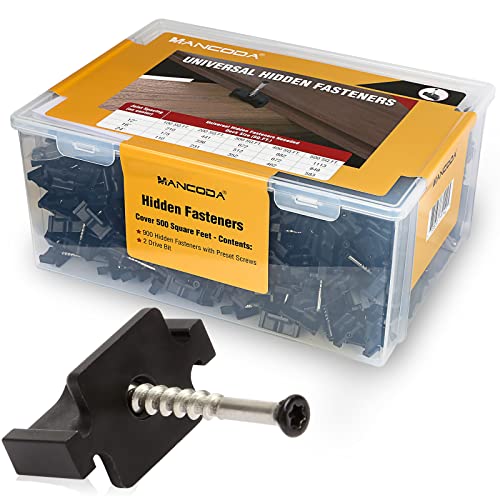 ManCoda Hidden Deck Fasteners for Composite Decking Board, Universal Hidden Fasteners with Stainless Steel Screws, Composite Decking Clips for Wood Deck Framing, 900 Pack for 500 SQ.FT.$239.00Check price on Amazon
Check: That the clip is approved by your board maker and sets the gap you want
- No screw heads on the walking surface
- Sets an even gap automatically
- Fast once the rhythm is set
- Only for grooved boards
- Replacing a middle board is fiddly
- Costs more per square foot than screws
Edge-screw jig (angled screws through the board edge)
Best for: Square-edge wood or composite boards without grooves
See options on AmazonCheck: Which board thicknesses the jig fits and the special screws it needs
- Hidden fastening without grooved boards
- Works with many wood species
- Screws can be backed out
- Slower than face-screwing
- Uses its own screws, so less choice
- Hard to fasten the last board against a wall
Face-screw and plug system
Best for: Composite and PVC boards where you want a near-invisible face fastening
See options on AmazonCheck: A plug colour matched to your board line and the setting tool depth
- Very strong — screws go straight down into the joist
- Plugs hide the heads and match the board
- Square-edge boards can be used
- Plugs must be colour-matched to the board line
- Extra step for every screw
- Board replacement means drilling out plugs
Face-driven deck screws
Best for: Pressure-treated and cedar decks, and budget builds
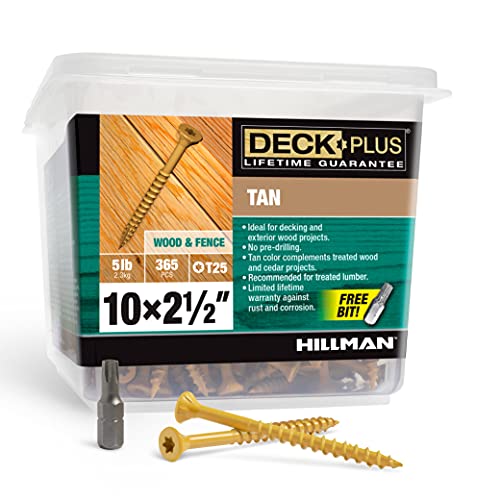 Deck Plus Deck Screws, #10 x 2-1/2in, 365 Pieces,5 Lb Box, Tan$29.98Check price on Amazon
Check: Coating rated for treated lumber (or stainless near salt water) and the drive type
- Cheapest and fastest method
- Easy to replace a single board
- Strongest hold-down for wood that cups
- Heads show on the walking surface
- Heads can rust-stain if the coating is wrong
- Two screws per joist means many holes
Board spacing tool
Best for: Keeping the gap even when face-screwing or using an edge jig
 8 Pcs ABS Deck Spacer Tool, 4 Thicknesses Orange Deck Board Spacers$9.99Check price on Amazon
Check: The gap size it sets and whether it fits your board thickness
- Even gaps look better and drain properly
- Cheap
- Speeds up layout
- Not needed with clips that set their own gap
- Wet pressure-treated boards shrink, so the gap changes
| Type | Current option | Pros | Cons |
|---|---|---|---|
| Hidden clips for grooved boardsBest for: Grooved-edge composite and PVC boardsCheck: That the clip is approved by your board maker and sets the gap you want | ManCoda Hidden Deck Fasteners for Composite Decking Board, Universal Hidden Fasteners with Stainless Steel Screws, Composite Decking Clips for Wood Deck Framing, 900 Pack for 500 SQ.FT.$239.00Check price on Amazon |
|
|
| Edge-screw jig (angled screws through the board edge)Best for: Square-edge wood or composite boards without groovesCheck: Which board thicknesses the jig fits and the special screws it needs | See options on Amazon |
|
|
| Face-screw and plug systemBest for: Composite and PVC boards where you want a near-invisible face fasteningCheck: A plug colour matched to your board line and the setting tool depth | See options on Amazon |
|
|
| Face-driven deck screwsBest for: Pressure-treated and cedar decks, and budget buildsCheck: Coating rated for treated lumber (or stainless near salt water) and the drive type | Deck Plus Deck Screws, #10 x 2-1/2in, 365 Pieces,5 Lb Box, Tan$29.98Check price on Amazon |
|
|
| Board spacing toolBest for: Keeping the gap even when face-screwing or using an edge jigCheck: The gap size it sets and whether it fits your board thickness | 8 Pcs ABS Deck Spacer Tool, 4 Thicknesses Orange Deck Board Spacers$9.99Check price on Amazon |
|
|
Prices as of Oct 3, 2026, 4:36 AM UTC. Product prices and availability are accurate as of the date/time indicated and are subject to change. Any price and availability information displayed on Amazon.com at the time of purchase will apply to the purchase of this product.
How many fasteners a 300 sq ft deck takes
Count before you buy; clips and screws are sold in kits or boxes sized for a certain area. The example uses the deck fastener calculator function with 5.5 in boards on joists 16 in on centre.
Worked example: 300 sq ft deck, 5.5 in boards, joists 16 in on centre
- Face screws, two per joist: 1,045 screws (3.5 per sq ft) → 3 × 5 lb boxes
- Hidden clips, one per joist crossing: 523 clips → 6 kits of 90
- Both counts include 10% for butt joints, board ends and dropped fasteners
1,045 face screws or 523 hidden clips — clips are half the count but cost more each.
Need the number of boards first? Use the deck board calculator, and the deck board gap calculator for the spacing.
Which system for which board
| Decking | Use | Why |
|---|---|---|
| Pressure-treated pine | Coated deck screws | Cheap, strong and easy to replace boards; wet boards shrink so gaps set themselves |
| Cedar or redwood | Stainless or coated deck screws, or an edge jig | Avoid fasteners that react with the tannins and stain the wood |
| Grooved composite or PVC | The maker's hidden clips | Keeps the warranty and the gap correct |
| Square-edge composite or PVC | Matched face-screw and plug system | Hidden heads without grooves |
| Hardwoods such as ipe | Clips or an edge system made for hardwood, with pre-drilling | Dense wood splits without pilot holes |
| Near salt water | Stainless steel fasteners | Coated steel corrodes faster in salt air |
Safety notes
- Wear eye protection when driving screws; a slipped bit or snapped screw head can fly.
- Use a drill or impact driver with a clutch or depth setting so screws do not overdrive and cut through composite surfaces.
- Kneel on pads and keep loose boards and fastener boxes off walkways while working.
Frequently asked questions
What are the best hidden deck fasteners?
For grooved composite or PVC boards, the clip system the board maker approves. For square-edge boards, an edge-screw jig or a face-screw and plug system. Follow the board maker's list, because the wrong fastener can void the warranty.
Are hidden deck fasteners worth it?
They give a cleaner surface with no screw heads, which suits composite and PVC decks. They cost more and make single-board replacement harder, so face screws remain a good choice on pressure-treated wood.
How many deck screws per square foot?
About 3.5 per square foot for 5.5 in boards on joists 16 in on centre with two screws per joist, including 10% extra. The deck fastener calculator works it out for other board widths and spacings.
Can you use hidden fasteners on pressure-treated wood?
Yes, with an edge-screw jig or a clip made for square-edge or grooved wood boards. Wet pressure-treated boards shrink as they dry, so allow for the gap opening up.
Do composite decks need special screws?
Yes. Use the fastener or screw system the board maker lists. Ordinary wood deck screws can mushroom the surface of composite boards.
Get your deck estimate in 60 seconds
Free, no signup required.